

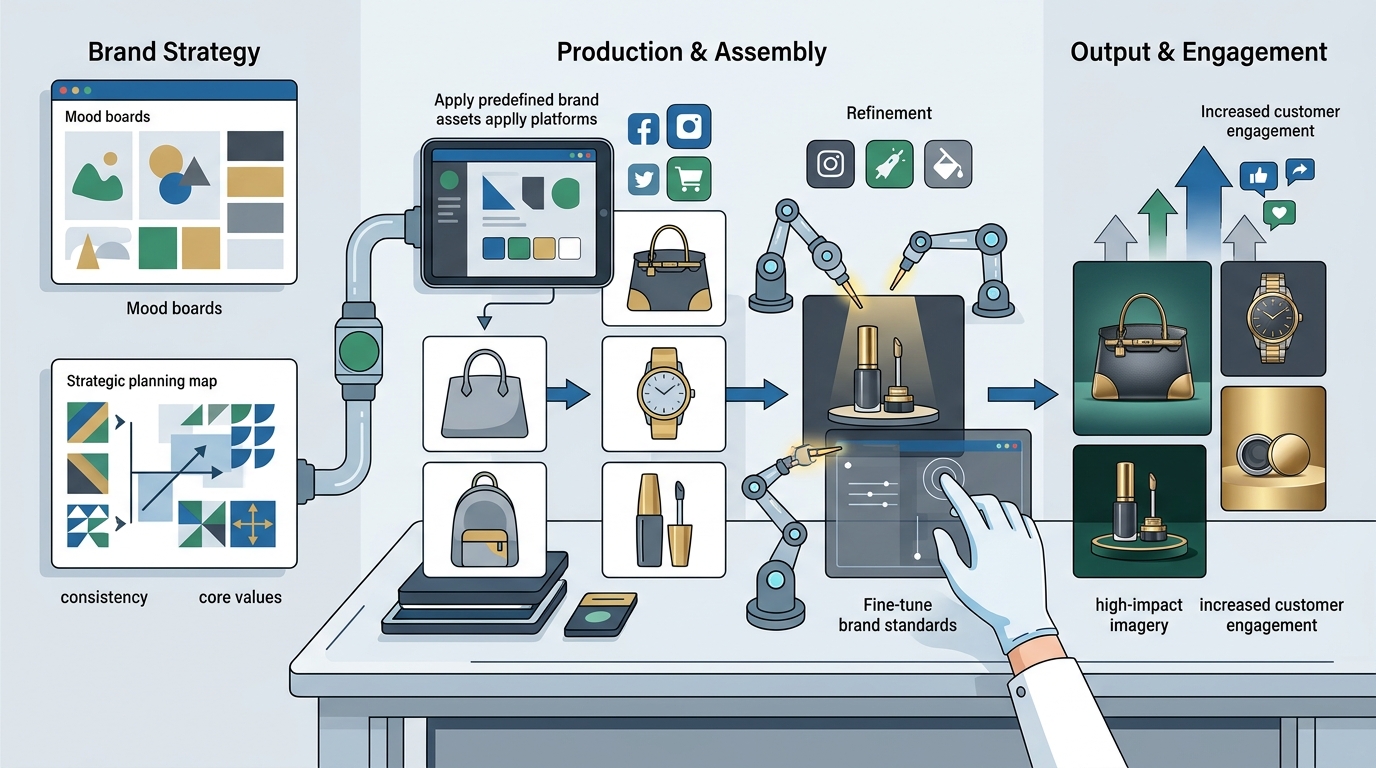
Brand visual design is the systematic process of creating consistent, high-impact imagery that communicates your core business values to target audiences. According to recent industry data, companies that prioritize professional visual assets experience a 47 percent increase in customer engagement across digital channels. Building a cohesive visual identity requires strategic planning, specialized tools, and a clear understanding of platform-specific requirements. This guide outlines the exact workflow top brands use to produce conversion-ready imagery without relying on expensive studio shoots.
Understanding Brand Visual Design Fundamentals
Establishing a strong visual foundation requires more than aesthetic preferences. You must align every image, color palette, and typographic choice with your core business objectives. Brand visual design is the strategic application of imagery, typography, and color systems to establish immediate market recognition. When these elements work in unison, they reduce cognitive friction for shoppers and accelerate purchasing decisions. Brands that maintain strict visual consistency across all touchpoints typically see higher retention rates and stronger market positioning. Start by auditing your existing assets to identify gaps in your current visual strategy. Document your core brand values, target demographics, and primary conversion goals before commissioning or generating new imagery. This foundational step prevents costly redesigns and ensures every visual asset serves a measurable business purpose.
Defining Your Visual Voice
Your visual voice dictates how customers perceive your brand before they read a single word. High-quality visuals must reflect your brand personality, whether that leans toward minimalist sophistication, bold experimentation, or approachable reliability. Create a comprehensive brand style guide that specifies exact hex codes, font hierarchies, image filters, and composition rules. Distribute this guide to all marketing teams, freelancers, and automated systems. Consistency builds trust, and trust drives repeat purchases.
Selecting the Right Production Workflow
Traditional photography studios remain expensive and slow. Modern brands now leverage automated systems to generate studio-quality assets at scale. AI visual marketing is the automated generation of product imagery, lifestyle shots, and promotional graphics using machine learning models. These systems analyze your product data, apply realistic lighting models, and place items in contextually appropriate environments. This approach drastically reduces production timelines while maintaining commercial-grade output. Review successful implementations to understand how automated workflows integrate with existing marketing stacks. You can generate hundreds of variations in hours instead of weeks. This speed allows you to test multiple creative angles and double down on the highest converting visuals.
Integrating Automation with Creative Direction
Automation does not replace creative strategy. It amplifies it. Your marketing team should still define the core messaging, target demographics, and brand guidelines. The automated system then executes these directives across dozens of formats and platforms. This hybrid approach ensures brand safety while maximizing output velocity. Explore how leading companies structure their automated pipelines to maintain quality control. You will find that clear input parameters yield predictable, high-quality outputs.
Optimizing Imagery for E-Commerce Platforms
Platform-specific requirements dictate how your visuals perform in search results and shopping feeds. Each marketplace enforces distinct resolution standards, background rules, and file format restrictions. According to platform analytics, optimized product images drive a 35 percent higher conversion rate when they meet strict technical specifications. You must adapt your core assets to fit these varying constraints without sacrificing brand identity. White background requirements dominate major marketplaces, while lifestyle imagery performs better on social channels and brand websites. Develop a master asset library that stores high-resolution originals. From there, generate platform-specific derivatives automatically. This method eliminates manual resizing errors and ensures compliance across every sales channel. Leading retailers report that standardized image libraries reduce operational overhead by nearly forty percent.
Mastering Platform Compliance
Non-compliant visuals get rejected by automated review systems, delaying your product launches. Learn the exact pixel dimensions, file size limits, and background transparency rules for each major platform. Build a compliance checklist that your production team reviews before every upload. This proactive approach prevents costly delays and maintains your seller rating. Consistent compliance also signals professionalism to both algorithms and shoppers.
Implementing a Scalable Content Pipeline
Scaling visual production requires a structured workflow that balances speed with quality control. You need a centralized dashboard to manage credits, track project status, and approve final assets. Content pipeline management is the systematic organization of asset creation, review, approval, and distribution across multiple marketing channels. When you centralize these operations, you eliminate version control errors and reduce communication bottlenecks. Assign clear roles for creative direction, technical generation, quality assurance, and final publishing. This division of labor ensures that no critical step is overlooked during high-volume production cycles. Implement automated notifications for project milestones and approval requests. This transparency keeps your entire team aligned and accountable. Industry case studies demonstrate that centralized pipelines reduce time-to-market by over fifty percent.
Managing Credits and Resource Allocation
Automated systems typically operate on a credit-based pricing model. You must forecast your monthly visual output to allocate credits efficiently. Prioritize high-impact assets like hero banners, main product shots, and campaign creatives. Reserve remaining credits for seasonal updates and promotional materials. Track your credit consumption weekly to avoid unexpected service interruptions. Adjust your generation parameters to maximize output per credit. This financial discipline ensures sustainable growth without inflating operational costs.
Measuring Visual Performance and Iterating
Creating visuals is only half the equation. You must track how each asset performs in live campaigns. Data shows that brands updating their visual assets quarterly see a 22 percent growth in brand recall. You need to monitor click-through rates, add-to-cart percentages, and overall engagement metrics for every creative variation. A/B testing remains the most reliable method for identifying top-performing visuals. Test different backgrounds, lighting conditions, and model poses to determine what resonates with your specific audience. Document your findings in a centralized performance dashboard. Use these insights to refine your next generation cycle. Continuous iteration ensures your visuals stay relevant and competitive. Market research indicates that data-driven visual optimization directly correlates with long-term revenue expansion.
Establishing Feedback Loops
Feedback loops connect your creative output to actual business results. Connect your visual assets to your analytics platform to track user behavior post-click. Identify which visual elements drive the highest engagement and replicate those patterns in future campaigns. Remove underperforming assets from your active library to prevent wasted ad spend. Regular performance reviews keep your visual strategy aligned with shifting consumer preferences. This agile approach prevents creative stagnation and maintains market relevance.
Choosing Your Production Model
Businesses must select a production model that aligns with their budget, timeline, and quality expectations. Traditional studios offer hands-on creative control but require significant time and financial investment. Automated systems provide rapid scalability and predictable pricing but demand clear input parameters. Hybrid approaches combine the best of both worlds by using automation for bulk generation and human editors for final polish. Select the model that matches your current growth stage and long-term objectives. Review the comparison table below to evaluate your options.
| Production Model | Best Use Case | Estimated Cost | Turnaround Time | Quality Control |
|---|---|---|---|---|
| Traditional Studio Photography | High-end luxury goods, flagship campaigns | $5,000 to $25,000 per shoot | 2 to 4 weeks | Expert human review |
| Automated AI Generation | High-volume e-commerce, rapid testing | $0.50 to $3.00 per asset | Minutes to hours | Automated quality checks |
| Hybrid Production Workflow | Mid-market brands, seasonal campaigns | $2,000 to $8,000 monthly | 3 to 7 days | Mixed human and system review |
| Marketplace-Optimized Templates | Amazon sellers, marketplace compliance | $1,000 to $4,000 monthly | 1 to 3 days | Platform compliance verification |
Key Takeaways
- Companies prioritizing professional visual assets experience a 47 percent increase in customer engagement across digital channels.
- Automated systems can generate hundreds of platform-compliant variations in hours instead of weeks.
- Brands updating their visual assets quarterly see a 22 percent growth in brand recall.
- Centralized pipelines reduce time-to-market by over fifty percent compared to traditional workflows.
- Optimized product images drive a 35 percent higher conversion rate when they meet strict technical specifications.
- Leading retailers report that standardized image libraries reduce operational overhead by nearly forty percent.
- Over 50,000 brands currently trust automated visual generation systems to scale their marketing operations.
Frequently Asked Questions
How long does it take to generate high-quality brand visuals using automated systems?
Automated systems typically produce initial drafts within minutes. Final approval and platform-specific optimization usually require one to three business days. This timeline depends on your asset volume and revision requirements.
Can automated visuals match the quality of traditional studio photography?
Modern machine learning models now replicate studio lighting, realistic shadows, and accurate color rendering. While traditional photography retains niche advantages for extreme close-ups, automated visuals now meet commercial standards for most e-commerce and digital marketing applications.
What file formats and resolutions are required for major e-commerce platforms?
Most marketplaces require JPEG or PNG files at 1500 to 2000 pixels on the longest side. White background requirements dominate major platforms, while lifestyle imagery performs better on social channels and brand websites. Always verify current platform guidelines before uploading.
How do I calculate the return on investment for automated visual production?
Compare your previous studio costs against your new automated subscription fees. Factor in the time savings for your marketing team and the increased conversion rates from optimized imagery. Most brands achieve full ROI within the first two months of implementation.
What happens if my automated system generates inaccurate product details?
Quality assurance protocols flag discrepancies before publication. You can manually review flagged assets or adjust your input parameters to improve accuracy. Regular system updates and model training continuously reduce error rates across all production pipelines.
Can I integrate automated visuals directly into my existing marketing stack?
Yes. Most automated systems offer API integrations, direct platform connectors, and bulk export tools. You can sync your generated assets directly to your content management system, email marketing platform, and advertising dashboards.
Start Building Your High-Quality Visual Library Today
Stop wasting budget on slow, expensive studio shoots. Transition to a scalable, data-driven visual production system that delivers conversion-ready imagery on demand. Visit our platform homepage to explore pricing tiers, request a personalized demo, or access our comprehensive documentation. Your brand deserves visuals that perform as hard as you do. Begin your automated production workflow today and watch your engagement metrics climb.