

How to Generate a Mood Board for Your Brand's Visual Strategy
A mood board is a curated collection of visual references, including colors, images, typography, and textures, that communicates your brand's desired aesthetic and creative direction. For eCommerce brands and retailers competing across Amazon, Instagram, Shopify, and beyond, a well-crafted mood board is no longer optional. According to visual branding research, 93% of consumers say visual appearance is the key deciding factor in a purchase. This guide walks you through generating a mood board that aligns your visual strategy with real performance data, not guesswork.
What Is a Brand Mood Board?
A brand mood board is a visual representation of what you want your brand to feel like. It typically includes color palettes, font samples, photography style references, textures, and keywords that capture your brand personality. Think of it as a visual brief that aligns your entire team around one creative direction.
Mood boards serve as a reference point and source of inspiration for designers, marketers, and stakeholders involved in creating brand assets such as logos, website designs, packaging, and eCommerce product photography. They ensure consistency across every touchpoint, from social media feeds to marketplace listings.
Why Mood Boards Matter for Visual Strategy
Visual branding is not a nice-to-have. According to the U.S. Chamber of Commerce, more than half of all brand first impressions are visual. Color alone can increase brand recognition by up to 80%, making a consistent visual direction critical for conversion and recall.
For large brands operating across multiple channels, a mood board prevents misinterpretation, speeds up design decisions, and helps customers recognize your brand instantly. When your Amazon listing, Instagram feed, and Shopify storefront share the same visual language, you build trust and familiarity over time.
Mood Boards Drive Team Alignment
When multiple creatives, agencies, or international teams contribute to content production, a mood board acts as the single source of truth. It eliminates endless revision cycles by setting expectations visually before any asset is produced.
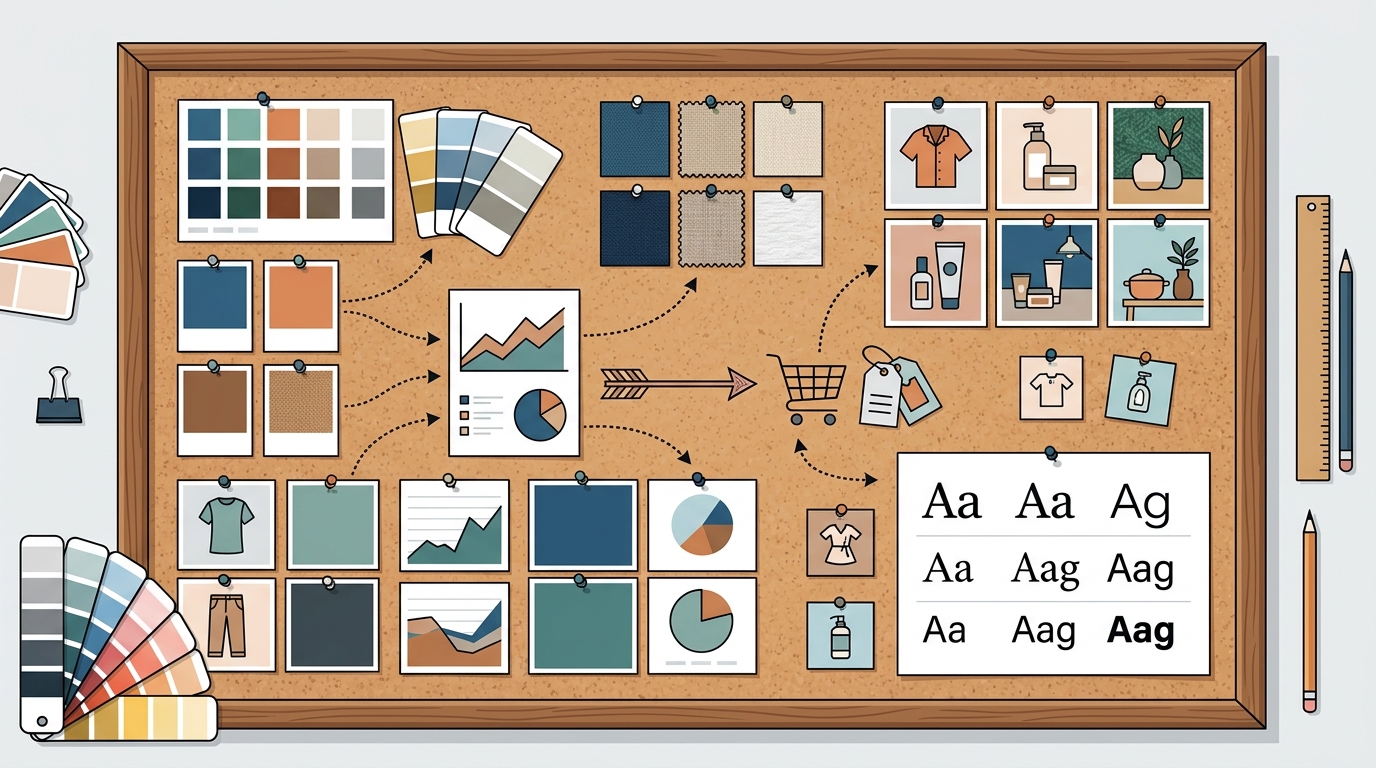
Traditional vs. Data-Driven Mood Boards
Not all mood boards are created equal. Traditional mood boards rely on aesthetic preference and inspiration, while data-driven mood boards incorporate competitive analysis and performance metrics. Here is how they compare:
| Feature | Traditional Mood Board | Data-Driven Mood Board |
|---|---|---|
| Source of inspiration | Designer intuition, Pinterest browsing | Competitor analysis across sales channels |
| Performance validation | None | Based on top-performing visuals in your category |
| Platform optimization | Generic | Tailored per platform (Amazon, Instagram, etc.) |
| Brand personalization | Manual curation | AI learns brand voice, color, and tone |
| Speed | Hours to days | Minutes with AI tools |
| Scalability | Low | High, across product categories |
Data-driven mood boards are increasingly becoming the standard for brands that need to move fast and produce content that converts. Dresma's AI mood board generator is a prime example of this approach, analyzing competitor visuals across Amazon, Instagram, and Pinterest to deliver strategic creative direction.
Step-by-Step: How to Generate a Mood Board
1. Define Your Brand Identity and Audience
Before selecting any visuals, clarify your brand archetype, target audience, and the emotions you want to evoke. A luxury skincare brand will have a dramatically different mood board than a playful children's toy company. Document your brand colors, fonts, and photography style preferences as a starting point.
2. Gather Visual References and Competitive Insights
Collect images, color swatches, typography samples, and textures that match your desired direction. Go beyond Pinterest. Analyze what top competitors in your category are doing on marketplaces and social platforms. Look at their best-performing listings, ad creatives, and social posts to understand what resonates with your shared audience.
3. Curate, Organize, and Validate
Narrow your references down to a focused collection. Each element should reinforce a consistent visual narrative. Remove anything that clashes or dilutes the core mood. If possible, validate your choices against performance data. Tools like Dresma's mood board generator automate this step by recommending visual formats and themes backed by real engagement metrics.
The AI-Powered Approach to Mood Boards
AI-powered mood board generation is a method that uses machine learning to analyze top-performing visual content across platforms and produce brand-specific creative direction. Rather than relying on gut instinct, AI scans competitor visuals, identifies trending content styles, and personalizes recommendations to your brand identity.
Dresma's approach follows a simple three-step process: first, upload your past content so the platform adapts to your aesthetic and product range. Second, the AI gauges your visual strategy against top competitors across Pinterest, Instagram, Amazon, and more. Third, Dresma recommends visual formats and themes aligned with your brand and audience preferences.
This process feeds directly into AI product photography workflows, where the mood board becomes the creative brief for generating lifestyle shots, flat lays, AI-generated product images, and ad creatives at scale. Every image passes through human quality checks to ensure authenticity and brand readiness.
Common Mistakes to Avoid
Over-cluttering: Including too many conflicting styles dilutes your visual message. Stick to one cohesive direction per mood board.
Ignoring platform context: A mood board for Instagram Reels should look different from one for Amazon product detail pages. Tailor your board to each channel's format and audience expectations.
Relying only on aesthetics: A beautiful mood board that does not reflect what actually performs in your product category will not drive conversions. Pair inspiration with data whenever possible.
Skipping team buy-in: A mood board only works if all stakeholders, from designers to brand managers, align on the direction before production begins. Share it early and iterate based on feedback.
Key Takeaways
- A mood board is a visual tool that communicates your brand's desired aesthetic, aligning teams and reducing revision cycles.
- More than half of brand first impressions are visual, making a strong mood board essential for trust and recognition.
- Data-driven mood boards outperform traditional ones by incorporating competitor analysis and platform-specific performance data.
- AI tools like Dresma's mood board generator automate competitive analysis and deliver personalized visual strategy recommendations in minutes.
- Always tailor mood boards to specific platforms such as Amazon, Instagram, or Shopify for maximum relevance.
- Validate your visual direction against real engagement metrics before scaling content production.
- Combine AI efficiency with human quality checks to ensure every asset meets brand standards.
Frequently Asked Questions
What is a mood board in visual marketing?
A mood board is a curated collection of images, colors, fonts, textures, and references that define a brand's visual direction. It acts as a shared creative brief for teams producing marketing content across channels.
How do I create a mood board for my eCommerce brand?
Start by defining your brand identity and audience. Gather visual references, analyze competitor content, and organize everything into a focused board. Tools like Dresma's AI mood board generator simplify this by automating competitive analysis and delivering data-backed recommendations.
What should a brand mood board include?
Include 3 to 5 brand color swatches with hex codes, primary and secondary fonts, photography style references, texture or pattern samples, and supporting keywords that capture your brand personality.
How is an AI mood board different from a traditional one?
An AI-powered mood board analyzes top-performing visuals across sales channels and platforms, then generates recommendations personalized to your brand. Traditional mood boards rely solely on manual curation and aesthetic intuition.
Can I use one mood board for all sales channels?
While your core brand identity stays consistent, you should adapt mood boards per platform. An Amazon product listing has different visual requirements than an Instagram campaign. Dresma's tool adapts recommendations to each platform automatically.
Why is competitive analysis important for mood boards?
Understanding what visual content performs best in your category helps you create assets that resonate with your target audience. Competitive analysis removes guesswork and grounds your creative direction in proven results.
How often should I update my brand mood board?
Review your mood board quarterly or whenever you launch a new product line, enter a new market, or notice shifts in visual trends within your category. Regular updates keep your content strategy current and competitive.
What tools can I use to create a mood board?
Popular options include Pinterest, Canva, and Adobe XD for manual curation. For data-driven, AI-powered mood boards tailored to eCommerce, Dresma's mood board generator provides competitive insights alongside creative direction.
Generate Your Data-Backed Mood Board Today
Stop building visual strategy on guesswork. Book a free demo with Dresma and discover how AI-powered mood boards can give your brand a competitive edge across every sales channel. Upload your brand content, let the platform analyze your category, and receive a personalized mood board that drives real results.